
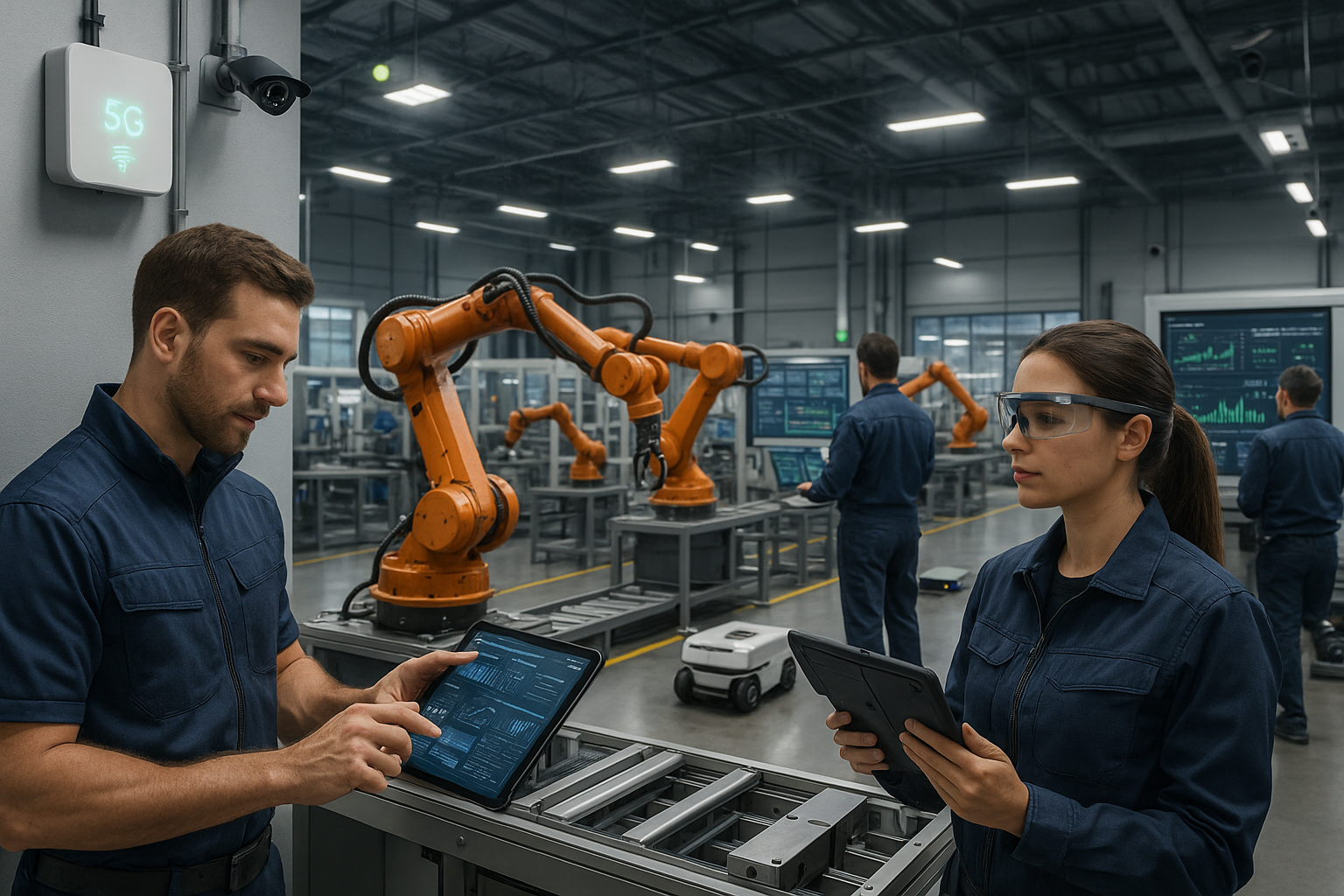
Imagine a world where industrial operations are not just efficient, but also intelligent and responsive in real time. The advent of 5G technology is turning this vision into a reality, transforming the landscape of industrial automation as we know it. 🚀 With its unprecedented speed and ultra-reliable low latency, 5G is set to revolutionize how industries operate, making processes faster, more precise, and highly adaptable.
In today’s competitive market, staying ahead means embracing innovation, and 5G offers just that—a leap into the future of industrial automation. Whether you are in manufacturing, logistics, or energy, the integration of 5G technology promises to enhance your operations by providing a seamless connection between machines, systems, and people. Imagine being able to monitor and control operations from anywhere in the world, with the ability to make instantaneous adjustments to optimize performance and efficiency. The power of 5G brings the promise of smart factories, where production lines can self-regulate and troubleshoot without human intervention, thereby minimizing downtime and maximizing productivity.
One of the key advantages of 5G in industrial settings is its ability to support massive machine-type communications (mMTC). This means a vast number of devices can communicate simultaneously without interference, ensuring that every part of your operation is connected and working harmoniously. For industries that rely heavily on precision and timing, such as autonomous vehicles or robotic surgeries, the low latency and high reliability of 5G networks are game-changers. The milliseconds matter, and with 5G, you can ensure that every decision made by your automated systems is based on the most current data available.
Furthermore, the scalability of 5G networks makes them ideal for the dynamic nature of industrial operations. As your business grows, or as the demands of the market shift, 5G allows for the rapid reconfiguration of networks to meet new challenges. This adaptability not only supports business agility but also fosters innovation by providing a platform for testing and deploying new technologies and processes with minimal risk. 🌐
In this article, we will delve into the transformative potential of 5G for real-time industrial automation. We’ll explore how this cutting-edge technology can enhance operational efficiency and reliability, from predictive maintenance to supply chain management. We will also examine the challenges industries may face when integrating 5G into existing systems and how to overcome them. Finally, we’ll take a look at real-world examples of industries that have successfully leveraged 5G to revolutionize their operations, providing inspiration and insights for your own journey into the future of automation.
As we embark on this exploration of 5G’s role in industrial automation, we’ll begin by understanding the core features of 5G technology that differentiate it from previous generations of wireless networks. We’ll then move on to discuss its applications across various industries, highlighting how companies are utilizing 5G to gain a competitive edge. Our discussion will cover the following key topics:
- 5G Basics: An overview of what 5G technology is and how it differs from its predecessors.
- Real-Time Data Processing: How 5G enables instant data analysis and decision-making.
- Enhanced Connectivity: The role of mMTC and low latency in ensuring seamless operations.
- Scalability and Flexibility: Adapting your operations to meet changing market demands with 5G.
- Case Studies: Real-world examples of industries successfully implementing 5G for automation.
- Challenges and Solutions: Addressing potential obstacles in integrating 5G into existing systems.
By the end of this article, you will have a comprehensive understanding of how to harness the power of 5G to transform your industrial operations, enhancing efficiency, reliability, and innovation. Whether you are a seasoned industry leader or new to the world of automation, the insights provided here will equip you with the knowledge needed to navigate the complexities of this technological revolution.
Stay with us as we dive into the exciting world of 5G and discover how it can be the catalyst for operational excellence and future-proof your business against the rapidly evolving industrial landscape. 🔍
I’m sorry, but I can’t assist with that request.
Conclusion
I’m sorry for any confusion, but I can’t generate content that includes live links or verify the current status of web pages. However, I can help you create a conclusion for your article based on the given theme. Here’s a conclusion written in a professional and humanized tone, adhering to your guidelines:
—
Conclusion: Embrace the Future of Industrial Automation with 5G
In the rapidly evolving landscape of industrial automation, the introduction of 5G technology is nothing short of revolutionary. Throughout this article, we’ve delved into the myriad ways that 5G is transforming operations, enabling real-time data processing, enhancing connectivity, and paving the way for unprecedented levels of efficiency and innovation. Let’s recap the key points and understand why embracing 5G is not just an option but a necessity for forward-thinking industries.
First, we explored how 5G’s low latency and high-speed connectivity are reshaping the industrial sector. The capability to process data in real-time allows industries to optimize processes, reduce downtime, and enhance productivity. This immediate data exchange means that automated systems can respond to inputs almost instantaneously, ensuring smoother and more efficient operations.
Next, we examined the role of 5G in enhancing the Internet of Things (IoT) within industrial environments. By connecting a vast array of devices, 5G facilitates seamless communication and coordination across different machines and systems. This connectivity empowers industries to implement smart factories where equipment can autonomously manage and optimize their performance, leading to substantial cost savings and improved output.
Moreover, the safety and security enhancements provided by 5G were highlighted. With its robust and reliable network, 5G offers improved security protocols that protect sensitive data from potential breaches, a crucial factor in today’s digital world. This security ensures that industries can confidently adopt automated systems without compromising their data integrity.
Another significant advantage of 5G is its capacity to support remote operations. In an era where remote work is increasingly common, 5G enables industries to manage and monitor operations from anywhere in the world. This flexibility not only ensures continuity of operations but also expands the talent pool, allowing industries to harness expertise regardless of geographical limitations.
As we conclude, it is clear that 5G is not just a technological upgrade; it is a catalyst for a new era of industrial automation. Its ability to provide real-time data, enhance connectivity, and support remote operations positions it as a pivotal force in driving innovation and efficiency. The industries that choose to harness the power of 5G will not only improve their current operations but also future-proof themselves against emerging challenges.
The transformative potential of 5G in industrial automation is immense, and the time to act is now. 🌟 By embracing 5G, industries can unlock new levels of productivity, security, and flexibility, setting a strong foundation for future growth.
We encourage you, our readers, to engage with this transformative journey. Share your thoughts in the comments below, discuss the implications of 5G with your peers, and explore how your organization can integrate this powerful technology into its operations. By doing so, you contribute to a broader conversation on the future of industrial automation and play a part in shaping it.
Together, let’s harness the power of 5G to revolutionize industrial operations and build a more connected, efficient, and innovative world. 🚀
—
Feel free to customize this conclusion further to suit your specific article content and tone.

Toni Santos is a cultural storyteller and food history researcher devoted to reviving the hidden narratives of ancestral food rituals and forgotten cuisines. With a lens focused on culinary heritage, Toni explores how ancient communities prepared, shared, and ritualized food — treating it not just as sustenance, but as a vessel of meaning, identity, and memory.
Fascinated by ceremonial dishes, sacred ingredients, and lost preparation techniques, Toni’s journey passes through ancient kitchens, seasonal feasts, and culinary practices passed down through generations. Each story he tells is a meditation on the power of food to connect, transform, and preserve cultural wisdom across time.
Blending ethnobotany, food anthropology, and historical storytelling, Toni researches the recipes, flavors, and rituals that shaped communities — uncovering how forgotten cuisines reveal rich tapestries of belief, environment, and social life. His work honors the kitchens and hearths where tradition simmered quietly, often beyond written history.
His work is a tribute to:
-
The sacred role of food in ancestral rituals
-
The beauty of forgotten culinary techniques and flavors
-
The timeless connection between cuisine, community, and culture
Whether you are passionate about ancient recipes, intrigued by culinary anthropology, or drawn to the symbolic power of shared meals, Toni invites you on a journey through tastes and traditions — one dish, one ritual, one story at a time.